
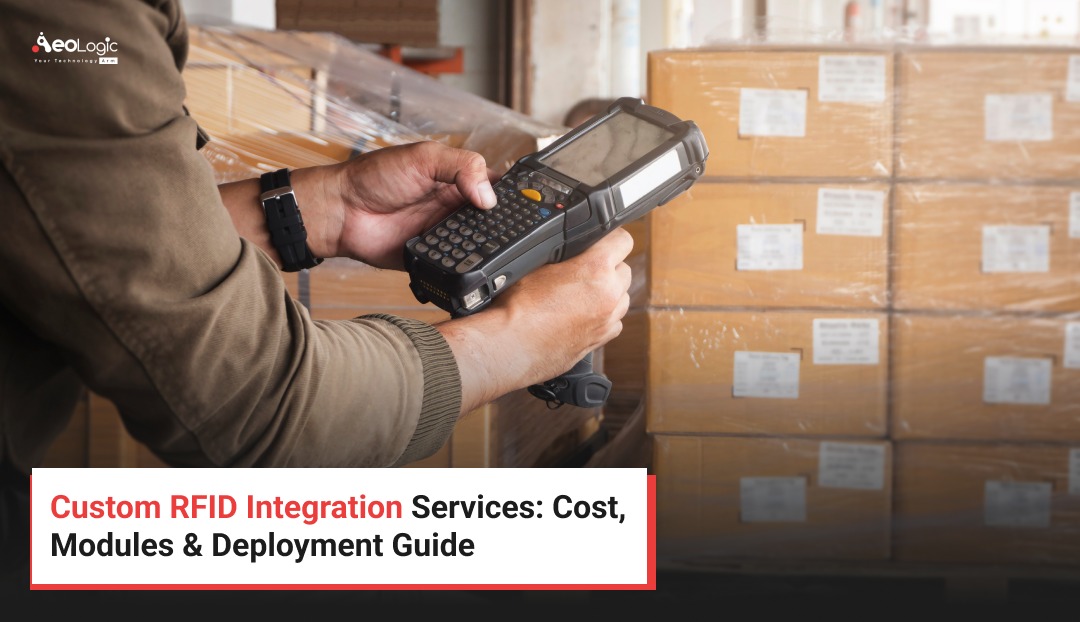

Businesses today operate in an environment where speed, accuracy, and visibility define success. Consequently, manual tracking systems, disconnected data sources, and outdated inventory practices fail to meet modern operational demands. Therefore, Custom RFID Integration actively enables digital efficiency.
Radio Frequency Identification, commonly known as RFID, has been around for years. However, its real value is unlocked when it is tailored to specific business workflows rather than applied as a generic solution. These services allow organizations to design, deploy, and scale RFID systems that fit their exact operational needs, industry requirements, and long-term growth goals.
This guide explores the full scope of RFID Integration, including costs, system modules, deployment strategies, benefits, challenges, and future trends. Whether you are in retail, manufacturing, logistics, healthcare, or asset management, this article will help you understand how customized RFID solutions drive measurable business transformation.
Understanding Custom RFID Integration: Definition and Purpose
Custom RFID Integration refers to the process of designing and implementing RFID systems that meet a business’s unique operations, infrastructure, and objectives. Moreover, unlike off-the-shelf RFID solutions, custom integration actively aligns hardware, software, data flows, and workflows into a unified, purpose-built system.
An RFID system typically includes tags, readers, antennas, middleware, and backend software. On the other hand, this technology ensures these components work seamlessly with existing enterprise systems such as ERP, WMS, CRM, or supply chain platforms. In addition, the customization can involve tag selection, reader placement, data filtering rules, analytics dashboards, and automation logic.
At its core, RFID Integration is not just about tracking items. Rather, it is about creating real-time visibility, improving decision-making, reducing manual effort, and enabling intelligent automation across business processes.
Importance of Tailored RFID Integration in Today’s Operations
Achieving Real-Time Visibility Through Custom RFID Integration
Modern businesses thrive on accurate, real-time information. As operational complexity increases, manual tracking methods struggle to keep pace. Furthermore, Custom RFID Integration empowers organizations to automatically capture and process data as assets move through facilities and supply chains. This real-time visibility improves decision-making, reduces human error, and ensures operations remain responsive and efficient.
Strengthening Global Supply Chain Transparency
Today’s supply chains span multiple regions, partners, and distribution points. Without precise tracking, delays and losses can quickly escalate. Additionally, RFID solutions allow businesses to monitor inventory, equipment, and shipments across locations without manual intervention. Moreover, by providing continuous insight into movement and status, RFID helps organizations reduce bottlenecks, minimize delays, and maintain consistent service levels.
Industry-Specific Optimization Through Tailored RFID Systems
Different industries have different operational realities. In healthcare, customized RFID solutions enhance patient safety, track critical equipment, and support regulatory compliance. Thus, retailers rely on tailored RFID systems to improve inventory accuracy and enable seamless omnichannel fulfillment. Manufacturing organizations benefit from customized RFID deployments that support lean production, asset tracking, and predictive maintenance. These outcomes depend on solutions designed for real-world environments, not generic implementations.
Scalable Custom RFID Integration for Future Business Growth
Adaptability is essential in today’s fast-changing markets. Therefore, Custom RFID Integration is built with scalability in mind, allowing businesses to expand locations, introduce new workflows, or integrate additional systems without major reengineering. This flexibility ensures long-term value and supports sustainable digital growth.
Key Benefits of Custom RFID Integration
Real-Time Operational Visibility
Custom RFID Integration provides instant insight into asset location, inventory levels, and process status across facilities. This visibility allows businesses to make faster, data-driven decisions.
-
Live tracking of inventory, equipment, and assets
-
Immediate alerts for discrepancies or delays
-
Reduced dependency on manual reporting
Improved Accuracy and Error Reduction
Manual tracking often leads to inaccuracies that impact costs and customer satisfaction. Customized RFID systems significantly improve data accuracy.
-
Near-perfect inventory accuracy
-
Reduced human errors in data entry
-
Lower risk of stockouts and overstocking
Increased Efficiency and Cost Savings
Additionally, Custom RFID Integration automates workflows and actively reduces operational overhead.
-
Faster receiving, picking, and shipping processes
-
Lower labor costs through automation
-
Optimized resource utilization
Integrating Enterprise Systems with Custom RFID Solutions
Custom RFID Integration ensures smooth connectivity with existing business systems such as ERP, WMS, or CRM platforms.
-
Unified data across departments
-
Real-time synchronization of information
-
Improved cross-functional collaboration
Enhanced Security and Compliance
RFID enables better control and traceability of assets, especially in regulated environments.
-
Improved asset protection and loss prevention
-
Automated audit trails and compliance reporting
-
Secure access monitoring
Scalability for Long-Term Growth
Custom-built RFID solutions are designed to evolve with business needs.
-
Easy expansion to new locations or workflows
-
Support for future digital initiatives
-
Long-term ROI through adaptable infrastructure
Core Modules in a Custom RFID Integration System
A well-designed Custom RFID Integration solution consists of several core modules, each serving a specific function within the system.
RFID Tags and Labeling Strategy
Tags are selected based on environment, durability, read range, and data requirements. Custom integration ensures the right tag type is used for each asset or product category.
RFID Readers and Antenna Infrastructure
Reader placement and antenna configuration are customized to ensure accurate reads while minimizing interference. This is especially critical in warehouses, factories, and hospitals.
RFID Middleware
Middleware acts as the brain of the system. It filters raw RFID data, applies business rules, and ensures only meaningful events are passed to enterprise systems.
System Integration Layer
This module connects RFID data with ERP, WMS, MES, or other business platforms. Custom RFID Integration ensures seamless data flow and real-time synchronization.
Analytics and Reporting Dashboard
Customized dashboards provide role-based insights, alerts, and performance metrics. Decision-makers can monitor operations in real time and identify issues proactively.
How Businesses Use Custom RFID Integration
Businesses use Custom RFID Integration in diverse ways depending on industry and operational goals.
Step 1: Identifying Business Goals and Use Cases
Businesses begin by defining what they want to achieve with Custom RFID Integration. This may include improving inventory accuracy, tracking assets, enhancing security, or optimizing workflows. Clear objectives ensure the RFID system is aligned with operational priorities.
Step 2: Designing a Tailored RFID Architecture
Once goals are defined, a customized RFID architecture is designed. This includes selecting the right RFID tags, readers, antennas, and data capture points based on the environment, industry requirements, and operational layout.
Step 3: Integrating RFID with Existing Systems
Custom RFID Integration connects RFID data with enterprise platforms such as ERP, WMS, or supply chain systems. This step ensures real-time data synchronization, eliminating silos and enabling end-to-end visibility.
Step 4: Automating Processes and Workflows
Businesses use RFID data to automate key processes such as inventory updates, asset movement tracking, quality checks, and alerts. Automation reduces manual effort and accelerates operational efficiency.
Step 5: Monitoring, Analyzing, and Optimizing Performance
Finally, RFID-driven insights are used to monitor performance through dashboards and reports. Businesses continuously refine workflows, improve accuracy, and scale the solution as operations grow.
Cost Factors in Custom RFID Integration
The cost of Custom RFID Integration varies widely based on scope, complexity, and scale. Understanding cost components helps businesses plan realistic budgets and ROI expectations.
- Hardware costs include RFID tags, readers, antennas, and networking equipment. These costs depend on read range, durability, and environmental conditions.
- Software and integration costs often represent a significant portion of the investment. Custom middleware, system integration, dashboards, and analytics require skilled development and testing.
- Deployment and configuration costs include site surveys, reader installation, calibration, and pilot testing. Custom RFID Integration emphasizes accuracy and reliability, which requires careful planning.
Thus, ongoing costs include maintenance, support, system updates, and tag replenishment. However, these are often offset by operational savings and efficiency gains.
Deployment Strategy for Custom RFID Integration
Assessing Operational Requirements
A successful Custom RFID Integration begins with a detailed assessment of business processes, infrastructure, and objectives. This step helps identify critical tracking points, environmental challenges, and integration needs before implementation begins.
Conducting Site Surveys and Feasibility Analysis
Physical environments greatly impact RFID performance. First, teams conduct site surveys to evaluate layout, materials, interference risks, and read zones. This ensures optimal placement of readers and antennas for accurate data capture.
Launching a Controlled Pilot Program
Before full-scale deployment, businesses implement a pilot project in a limited area. Similarly, the pilot validates system performance, read accuracy, and workflow alignment while allowing teams to identify and resolve issues early.
Phased Rollout for Minimal Disruption
Instead of deploying RFID across all operations at once, businesses roll out the solution in phases. Hence, this approach minimizes operational disruption, supports gradual adoption, and ensures system stability at each stage.
Training, Adoption, and Change Management
Employee training is essential for long-term success. Shortly, teams are educated on RFID workflows, system usage, and operational benefits, ensuring smooth adoption and consistent utilization.Tailored RFID Systems
Continuous Monitoring and Optimization
Finally, after deployment, performance is continuously monitored. Data insights are used to fine-tune system configurations, improve efficiency, and support future expansion.
Challenges in Custom RFID Integration and Practical Solutions
Challenge: Signal Interference and Read Accuracy
Additionally, metal surfaces, liquids, and dense environments can interfere with RFID performance, often resulting in missed or duplicate reads.
Solution: Custom RFID Integration addresses this by selecting environment-specific tags, optimizing antenna placement, and fine-tuning reader power levels to ensure consistent and accurate data capture.
Challenge: Managing High Volumes of RFID Data
RFID systems generate large amounts of raw data, which can overwhelm systems if not properly filtered.
Solution: Customized middleware applies business rules to process only relevant events, reducing data noise and improving system performance.
Challenge: Integration with Legacy Systems
Many organizations rely on outdated ERP or operational systems that are not RFID-ready.
Solution: Custom integration layers and APIs bridge RFID data with existing platforms, enabling real-time synchronization without requiring the replacement of core systems.
Challenge: High Initial Implementation Costs
Upfront costs for hardware, software, and deployment can be a concern for businesses.
Solution: A phased deployment strategy with targeted pilot use cases helps demonstrate ROI early and spreads investment over time.
Challenge: Employee Resistance and Adoption Issues
Employees may resist new technologies due to unfamiliarity or fear of disruption.
Solution: Clear communication, hands-on training, and demonstrating tangible operational benefits help drive acceptance and long-term adoption.
Challenge: Scalability and Future Expansion
Poorly designed RFID systems can become rigid and costly to expand.
Solution: Custom RFID Integration is designed with scalability in mind, allowing easy expansion to new locations, workflows, and systems.
Actionable Insights for Businesses Considering Custom RFID Integration
Businesses should start with clear objectives. Defining what success looks like helps guide system design and investment decisions.
Start with a High-Impact Use Case
Focus on processes with frequent errors or delays.
Example: A manufacturing plant begins RFID integration by tracking high-value tools on the shop floor to reduce downtime and loss.
Conduct a Pilot Before Full Deployment
Validate performance in a controlled environment before scaling.
Example: A warehouse tests RFID-enabled pallet tracking in one zone to ensure read accuracy and workflow alignment.
Design for Harsh Industrial Environments
Select RFID tags and readers suited for metal, heat, dust, or moisture.
Example: An automotive factory uses rugged RFID tags for tracking components through welding and assembly lines.
Integrate RFID with Core Business Systems
Ensure seamless data flow into ERP or MES platforms.
Example: A manufacturing firm integrates RFID data with its production system to enable real-time work-in-progress visibility.
Plan for Scalability from Day One
Build an architecture that supports future growth.
Example: A multi-site manufacturer designs RFID workflows that can be easily replicated across new plants.
Future Trends in Custom RFID Integration
Custom RFID Integration is evolving rapidly as businesses demand smarter, more connected operational systems. One major trend is the integration of RFID with artificial intelligence and advanced analytics. By combining RFID data with AI, organizations can predict inventory needs, detect anomalies, and optimize workflows proactively rather than reactively. Cloud-based RFID platforms are also gaining traction. These solutions enable real-time visibility across multiple locations, simplify system management, and support scalable deployments without heavy on-premise infrastructure. As a result, cloud adoption actively increases the flexibility and cost-effectiveness of Custom RFID Integration.
Another emerging trend is deeper integration with IoT ecosystems. RFID is increasingly being combined with sensors, automation systems, and digital twins to create intelligent, connected environments in manufacturing, logistics, and healthcare. However, sustainability is shaping future RFID deployments as well. Reusable tags, eco-friendly materials, and energy-efficient readers are becoming priorities as organizations align technology investments with environmental goals.
Finally, user-centric design and automation will continue to drive adoption, making Custom RFID Integration easier to deploy, manage, and expand across complex business operations.
Conclusion
Custom RFID Integration has evolved into a strategic capability that enables real-time visibility, operational efficiency, and intelligent decision-making. By tailoring RFID systems to specific business needs, organizations can unlock far greater value than generic implementations ever deliver.
However, from cost optimization to process automation and future-ready scalability, RFID solutions support long-term business resilience in a rapidly changing digital landscape. When implemented with a clear strategy and expert guidance, it becomes a cornerstone of modern digital operations.
Thus, organizations looking to align RFID initiatives with broader digital transformation goals can benefit from experienced partners like Aeologic Technologies, who bring deep technical expertise and strategic insight to complex integration projects.
Frequently Asked Questions
Q1. What is Custom RFID Integration?
Custom RFID Integration involves designing and deploying RFID systems tailored to specific business workflows, systems, and objectives.
Q2. How long does a Custom RFID Integration project take?
Timelines vary by scope, but most projects include a pilot phase followed by phased deployment over several months.
Q3. Is Custom RFID Integration expensive?
Costs depend on scale and complexity, but the long-term ROI often outweighs the initial investment through efficiency gains.
Q4. Which industries benefit most from Custom RFID Integration?
Retail, manufacturing, logistics, healthcare, and asset-intensive industries see the greatest benefits.
Q5 Can RFID integrate with existing enterprise systems?
Yes, Custom RFID Integration is specifically designed to work seamlessly with ERP, WMS, and other business platforms.