
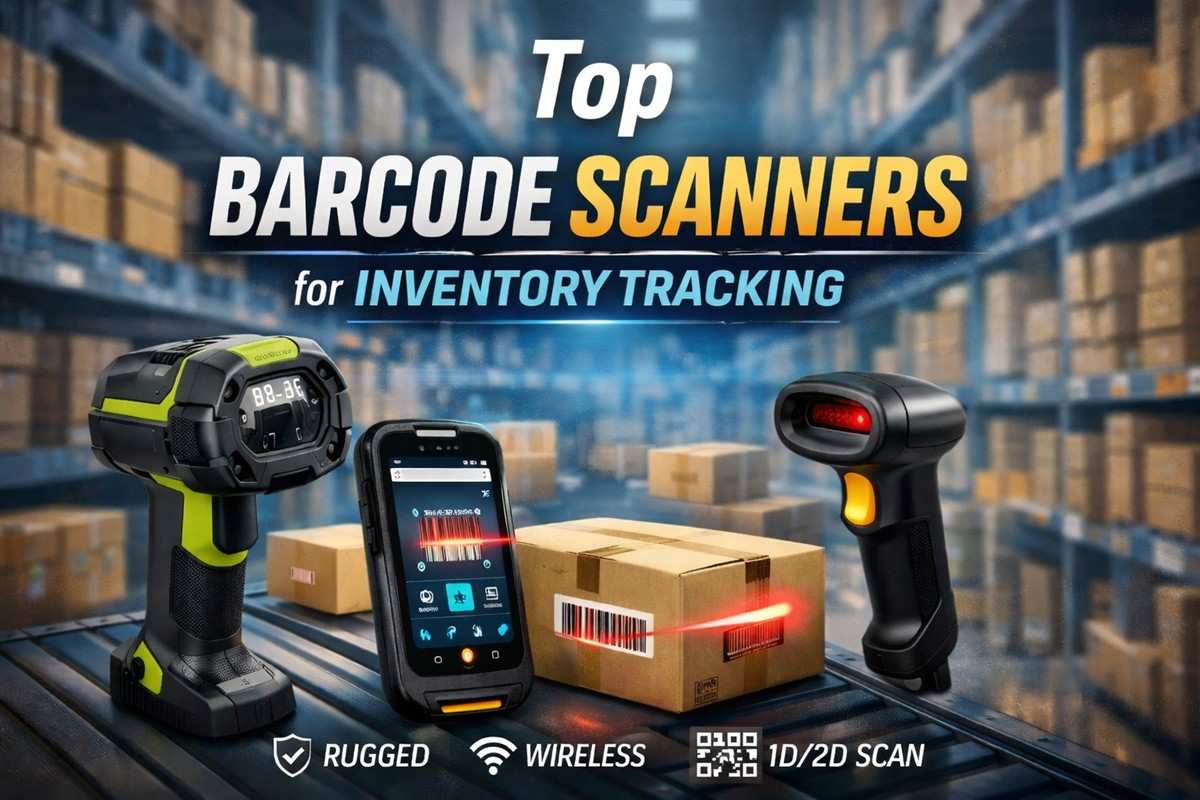

Inventory accuracy directly impacts profitability, customer satisfaction, and operational efficiency. In 2026, barcode scanners have become smarter, faster, more rugged, and better integrated with cloud-based inventory systems.
Whether you manage a warehouse, retail store, manufacturing unit, or eCommerce fulfillment center, choosing the right barcode scanner can significantly improve stock visibility and reduce errors.
In this detailed guide, we cover the top barcode scanners for inventory tracking in 2026, categorized by enterprise, mid-range, and budget options.
Why Barcode Scanners Still Matter in 2026
Even with RFID and IoT growth, barcode technology remains:
-
- Cost-effective
- Easy to implement
- Highly accurate
- Compatible with ERP & inventory systems
- Ideal for SMEs and large enterprises alike
Modern scanners now support:
- 1D & 2D barcode scanning
- QR codes
- Wireless & Bluetooth connectivity
- Rugged industrial environments
- Cloud inventory integration
1. Enterprise & Industrial Barcode Scanners
These scanners are built for warehouses, logistics hubs, and manufacturing plants.
1. Zebra DS3608
The Zebra DS3608 is designed for ultra-rugged environments. It withstands drops, dust, water, and extreme temperatures.
Key Features:
- Ultra-rugged IP-rated design
- Fast 1D and 2D barcode scanning
- Long-range scanning capability
- Ideal for warehouse & logistics
Best For: High-volume inventory tracking and distribution centers.
2. Zebra TC220K
The Zebra TC220K combines barcode scanning with Android-based mobile computing.
Key Features:
- Touchscreen interface
- Wi-Fi & Bluetooth connectivity
- Real-time inventory sync
- Works with ERP systems
Best For: Large warehouses and real-time stock tracking.
3. Honeywell 1472g
Best Wireless Enterprise Scanner
A powerful Bluetooth-enabled scanner ideal for dynamic inventory environments.
Key Features:
- Cordless scanning
- USB & Bluetooth support
- High-speed 2D scanning
- Durable build
Best For: Retail chains and medium-sized warehouses.
2. Mid-Range Barcode Scanners (Best Value for SMBs)
4. Zebra DS2208
Best Value Barcode Scanner in 2026
Affordable yet powerful, the DS2208 supports both 1D and 2D scanning.
Key Features:
- Plug-and-play setup
- USB connectivity
- Accurate and fast scanning
- Lightweight design
Best For: Small businesses and retail POS systems.
5. Newland NLS-HR3280-BT-SD
Best Bluetooth Scanner for Mobility
Reliable wireless performance with stable connectivity.
Key Features:
- Bluetooth scanning
- Comfortable ergonomic grip
- Long battery life
- Ideal for mobile stock checks
Best For: Field inventory audits and mobile retail teams.
6. Fingers 2D-QuickScan WL5
Best Budget Wireless Scanner
A practical wireless scanner offering solid performance at an affordable price.
Key Features:
- 2D barcode support
- Wireless & USB modes
- Easy setup
- Good battery backup
Best For: Growing startups and small retail outlets.
3. Budget Barcode Scanners
Ideal for small stores, startups, and limited inventory environments.
7. Helett HT20
Affordable All-in-One Scanner – Supports both wired and wireless scanning modes.
Key Features:
- 1D & 2D barcode support
- 4GHz wireless
- Cost-effective
- Easy integration
Best For: Small shops and startups.
8. iBall LS-392
Best Budget Wired Scanner – A simple plug-and-play wired scanner.
Key Features:
- USB connectivity
- Reliable 1D scanning
- Compact design
- Low maintenance
Best For: Billing counters and small retail stores.
How to Choose the Right Barcode Scanner in 2026
Before purchasing, consider:
1. 1D vs 2D Scanning
Choose 2D scanners if you use QR codes or digital barcodes.
2. Wired vs Wireless
- Wired → Fixed billing counters
- Wireless → Warehouses and mobile inventory
3. Ruggedness
Industrial environments require drop-resistant, IP-rated devices.
4. Integration Capability
Ensure compatibility with:
- ERP systems
- Inventory management software
- POS systems
- Cloud-based platforms
5. Budget & ROI
Investing in durable scanners reduces long-term maintenance and replacement costs.
Future Trends in Barcode Scanning (2026 & Beyond)
- AI-powered scanning accuracy
- Mobile computer integration
- Cloud-connected inventory devices
- Hybrid barcode + RFID systems
- Android-based smart scanners
Final Thoughts
The right barcode scanner can dramatically improve inventory accuracy, reduce manual errors, and speed up stock audits.
- For industrial use → Zebra DS3608
- For mobile warehouse tracking → Zebra TC220K
- For SMB retail → Zebra DS2208
- For budget needs → Helett HT20
Choosing the correct scanner depends on your business size, mobility needs, and integration requirements.
Frequently Asked Questions (FAQs)
1. What is the best barcode scanner for inventory tracking in 2026?
The best barcode scanner depends on your business needs. For industrial warehouses, the Zebra DS3608 is ideal. For small businesses, the Zebra DS2208 offers excellent value and performance.
2. What is the difference between 1D and 2D barcode scanners?
1D scanners read traditional linear barcodes (UPC, Code 128), while 2D scanners read QR codes and complex data matrices. Most modern inventory systems require 2D scanners for better flexibility.
3. Are wireless barcode scanners better than wired ones?
Wireless scanners provide mobility and are ideal for warehouses and large stockrooms. Wired scanners work best for fixed POS counters and billing stations where movement is limited.
4. Can barcode scanners integrate with ERP systems?
Yes, most modern barcode scanners integrate seamlessly with ERP, POS, and inventory management systems using USB, Bluetooth, or Wi-Fi connectivity.
5. How durable are industrial barcode scanners?
Industrial scanners are built for tough environments. For example, the Honeywell 1472g offers strong durability and reliable wireless performance for warehouse use.
6. What features should I look for in a barcode scanners for inventory tracking?
Key features include:
- 1D & 2D barcode support
- Fast scanning speed
- Wireless connectivity (if required)
- ERP compatibility
- Rugged build quality
7. Do barcode scanners work with cloud-based inventory systems?
Yes. Many modern scanners sync with cloud-based inventory platforms in real time, especially Android-based smart scanners like the Zebra TC220K.
8. How much does a good barcode scanner cost in 2026?
Prices vary:
- Budget models: ₹1,500 – ₹5,000
- Mid-range scanners: ₹7,000 – ₹15,000
- Industrial scanners: ₹20,000+
Your choice should depend on usage frequency and environment.
9. Can barcode scanners reduce inventory errors?
Yes. Barcode scanning reduces manual data entry errors, improves stock accuracy, speeds up audits, and enhances overall inventory control.
10. Is barcode technology still relevant in 2026?
Absolutely. While RFID and IoT are growing, barcode scanners remain the most cost-effective and widely adopted inventory tracking solution for businesses of all sizes.