
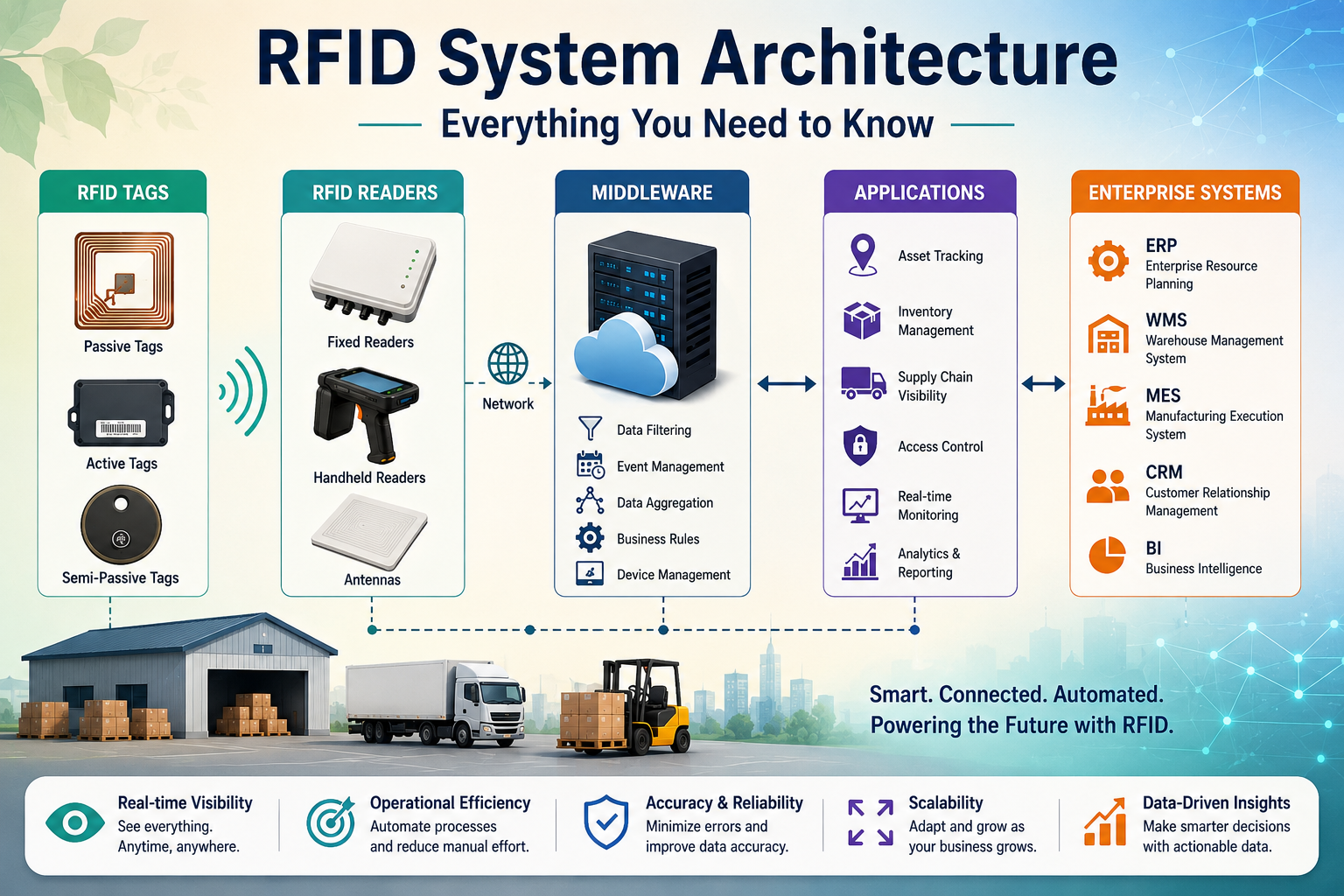

As businesses increasingly rely on automation, real-time visibility, and data-driven decision-making, Radio Frequency Identification (RFID) technology has emerged as a critical enabler of digital transformation. From inventory management and asset tracking to supply chain optimization and access control, RFID systems are helping organizations streamline operations while reducing manual effort and operational errors. At the core of every successful RFID deployment lies a well-designed RFID System Architecture, which serves as the foundation for seamless communication between RFID components, software platforms, and enterprise applications.
Understanding RFID System Architecture is essential for organizations planning to implement RFID technology or optimize existing deployments. The architecture determines how data is captured, transmitted, processed, stored, and integrated with business systems. A robust architecture not only ensures accurate and reliable data collection but also enables scalability, security, and real-time operational visibility across the organization. As RFID applications continue to expand across industries such as manufacturing, retail, healthcare, logistics, transportation, and warehousing, businesses need a comprehensive understanding of how RFID architecture works and how its various components interact.
This guide explores RFID System Architecture in detail, including its key components, working principles, architectural layers, deployment models, integration capabilities, challenges, and best practices. Whether you are a technology professional, business leader, or system integrator, understanding RFID architecture will help you maximize the value of RFID investments and build future-ready tracking and identification solutions.
What is RFID System Architecture?
RFID System Architecture refers to the structured framework that defines how various RFID components interact to collect, transmit, process, and utilize data. It encompasses the physical hardware components, communication networks, middleware platforms, databases, analytics engines, and enterprise software systems that work together to create a complete RFID ecosystem.
Unlike standalone identification technologies, RFID systems involve multiple interconnected layers that must operate seamlessly. The architecture governs the flow of information from RFID tags attached to assets, products, or equipment to RFID readers, middleware platforms, and business applications. This integrated approach enables organizations to capture real-time information automatically without requiring manual scanning or direct line-of-sight interaction.
A well-designed RFID System Architecture ensures efficient data collection, minimizes signal interference, supports high-volume transactions, and enables integration with existing business systems such as Enterprise Resource Planning (ERP), Warehouse Management Systems (WMS), Manufacturing Execution Systems (MES), and Customer Relationship Management (CRM) platforms.
Core Components of RFID System Architecture
The foundation of RFID System Architecture consists of several interconnected components that collectively enable automated identification and tracking. Each component plays a specific role in ensuring the efficient flow of information throughout the system.
RFID tags serve as the primary data carriers within the architecture. These tags contain microchips and antennas capable of storing unique identification information. Depending on the application, organizations may use passive, active, or semi-passive RFID tags. Passive tags rely on energy transmitted by RFID readers, while active tags contain internal batteries that enable longer communication ranges and enhanced functionality.
RFID readers function as communication gateways between tags and backend systems. These devices emit radio frequency signals that activate RFID tags and retrieve stored information. Readers can be fixed, handheld, vehicle-mounted, or integrated into industrial equipment depending on operational requirements.
Antennas are responsible for transmitting and receiving radio signals between RFID tags and readers. The selection of antenna type, placement, and configuration significantly influences system performance, read accuracy, and coverage area.
Communication networks facilitate the transmission of RFID data from readers to processing systems. These networks may include Ethernet, Wi-Fi, cellular connectivity, edge computing platforms, or cloud-based infrastructure depending on deployment requirements.
Middleware acts as the intelligence layer within RFID System Architecture. It filters, validates, aggregates, and manages RFID data before forwarding relevant information to enterprise applications. Middleware helps eliminate duplicate reads, reduce data noise, and improve overall system efficiency.
Databases and application servers store processed RFID information and support reporting, analytics, monitoring, and business process automation. These systems transform raw RFID data into actionable business insights.
Layers of RFID System Architecture
RFID System Architecture is commonly organized into multiple layers, each responsible for specific functions within the overall system. This layered approach simplifies management, improves scalability, and enhances integration capabilities.
The perception layer forms the physical foundation of the architecture. This layer includes RFID tags, readers, sensors, and antennas responsible for capturing real-world data. It serves as the primary interface between physical assets and digital systems.
The network layer handles communication and data transmission. Once RFID readers collect information from tags, the network layer ensures reliable transfer of data to middleware and backend systems through wired or wireless communication channels.
The middleware layer processes incoming RFID data before it reaches enterprise applications. It performs filtering, event management, business rule enforcement, device monitoring, and system orchestration functions. Middleware significantly improves data quality and operational efficiency.
The application layer provides business-specific functionality and user interaction. This layer includes inventory management systems, asset tracking platforms, supply chain applications, access control systems, and analytics dashboards. Business users interact with RFID-generated information through this layer.
The enterprise integration layer connects RFID systems with organizational software platforms. Through APIs, web services, and integration frameworks, RFID data becomes accessible across ERP, CRM, WMS, MES, and other business systems.
How RFID System Architecture Works?
RFID System Architecture works through a coordinated process that enables the automatic identification, tracking, and monitoring of assets, products, or individuals using radio frequency technology. The architecture ensures that data flows seamlessly from RFID tags to business applications, providing real-time visibility and actionable insights. Understanding each stage of this process helps organizations appreciate how RFID systems deliver accurate and efficient data capture.
RFID Tags Store and Transmit Data
The process begins with RFID tags attached to assets, products, equipment, or inventory items. Each tag contains a microchip that stores unique identification information and an antenna that enables communication with RFID readers. Depending on the type of RFID tag used, additional information such as product details, manufacturing data, location records, or maintenance history may also be stored.
When a tagged object enters the range of an RFID reader, the tag becomes ready to communicate. Passive tags receive energy from the reader’s radio waves, while active tags use their internal battery to transmit data over longer distances.
RFID Readers Capture Information
RFID readers are responsible for detecting RFID tags and collecting the information stored within them. These devices continuously emit radio frequency signals through connected antennas. When a tag enters the reader’s coverage area, communication is established automatically without requiring physical contact or direct line of sight.
The reader retrieves the tag’s identification data and converts the received radio signals into digital information. Modern RFID readers can simultaneously read multiple tags, making them highly effective for environments such as warehouses, manufacturing facilities, retail stores, and logistics hubs.
Antennas Enable Wireless Communication
Antennas play a critical role in RFID System Architecture by facilitating communication between tags and readers. They transmit radio frequency signals from the reader and receive responses from RFID tags.
The placement, orientation, and type of antenna significantly influence system performance. Properly designed antenna configurations ensure accurate tag detection, maximize read range, and minimize communication errors, especially in complex industrial environments.
Network Infrastructure Transfers Data
Once RFID readers capture tag information, the data is transmitted through the organization’s network infrastructure. This communication may occur through Ethernet connections, Wi-Fi networks, cellular networks, or edge computing devices.
The network layer ensures that RFID data reaches processing systems quickly and reliably. Efficient network connectivity is essential for supporting real-time monitoring and large-scale RFID deployments where thousands of tag reads may occur every minute.
RFID Middleware Processes Raw Data
After data is received from RFID readers, it is sent to RFID middleware, which acts as the intelligence layer of the architecture. Middleware filters, validates, and organizes the incoming information before it reaches enterprise applications.
This stage is particularly important because RFID readers may generate large volumes of raw data. Middleware removes duplicate reads, eliminates irrelevant information, applies business rules, and converts raw tag data into meaningful events that can be used by business systems.
For example, instead of recording hundreds of individual tag reads as a product moves through a warehouse, middleware can generate a single event indicating that the product has entered a specific storage area.
Databases Store RFID Information
Processed RFID data is then stored in centralized databases. These databases maintain records of asset movements, inventory status, equipment locations, shipment progress, and other operational information collected by the RFID system.
Data storage enables organizations to maintain historical records, conduct audits, generate reports, and perform advanced analytics. The database serves as a reliable repository for both real-time and historical RFID information.
Enterprise Applications Use RFID Data
Once stored and processed, RFID data becomes available to various enterprise applications. Systems such as Enterprise Resource Planning (ERP), Warehouse Management Systems (WMS), Supply Chain Management (SCM), Manufacturing Execution Systems (MES), and Asset Management platforms can access RFID-generated information.
These applications use RFID data to automate business processes, update inventory levels, track asset locations, monitor production workflows, manage shipments, and improve operational decision-making. The integration of RFID with enterprise software significantly enhances business efficiency and visibility.
Analytics and Reporting Generate Insights
The final stage of RFID System Architecture involves analytics and reporting tools that transform collected data into actionable business intelligence. Dashboards, reports, and visualization platforms provide real-time insights into inventory movements, asset utilization, operational bottlenecks, and supply chain performance.
Organizations can use these insights to optimize workflows, improve resource allocation, reduce losses, enhance customer service, and support strategic planning initiatives.
End-to-End Data Flow in RFID System Architecture
The complete workflow of RFID System Architecture follows a continuous cycle where RFID tags generate data, readers capture information, networks transfer data, middleware processes events, databases store records, enterprise applications utilize information, and analytics platforms generate business insights. This end-to-end architecture enables organizations to achieve real-time visibility, automation, and operational efficiency across their entire business ecosystem.
RFID System Architecture Deployment Models
Organizations can deploy RFID System Architecture using various models depending on operational requirements, scalability goals, and infrastructure preferences.
On-premises deployments provide complete control over RFID infrastructure and data management. These architectures are commonly used in highly regulated industries where data security and compliance are critical priorities.
Cloud-based RFID architectures offer scalability, flexibility, and reduced infrastructure costs. Organizations can access RFID data from multiple locations while benefiting from centralized management and automatic system updates.
Hybrid architectures combine on-premises and cloud environments to balance security, performance, and scalability. This approach enables organizations to maintain critical operations locally while leveraging cloud capabilities for analytics and remote monitoring.
Edge-enabled RFID architectures process data closer to the source, reducing latency and bandwidth requirements. This model is particularly beneficial for industrial environments requiring real-time decision-making and rapid response capabilities.
Benefits of a Well-Designed RFID System Architecture
A properly designed RFID System Architecture delivers significant operational and strategic benefits. Real-time visibility allows organizations to monitor assets, inventory, equipment, and products throughout their lifecycle. Automated data capture reduces human error while improving operational accuracy and efficiency.
Scalability enables organizations to expand RFID deployments as business requirements evolve. Integration capabilities ensure seamless connectivity with enterprise applications, supporting end-to-end digital transformation initiatives. Enhanced analytics and reporting provide valuable insights that support optimization, forecasting, and strategic decision-making.
Furthermore, RFID architecture improves asset utilization, reduces losses, strengthens compliance, enhances customer service, and contributes to overall operational excellence across multiple business functions.
Challenges in RFID System Architecture
Despite its advantages, RFID System Architecture presents several implementation challenges. Signal interference caused by metal surfaces, liquids, and environmental conditions can impact read accuracy. Infrastructure costs, system complexity, and integration requirements may also create implementation barriers for some organizations.
Managing large volumes of RFID-generated data requires effective middleware and data processing capabilities. Security concerns related to unauthorized access, data privacy, and network vulnerabilities must also be addressed through robust security frameworks and governance policies.
Organizations can overcome these challenges through proper planning, technology selection, pilot testing, and collaboration with experienced RFID solution providers.
Best Practices for Designing RFID System Architecture
Successful RFID implementations begin with clearly defined business objectives and operational requirements. Organizations should conduct site assessments to identify environmental factors that may affect RFID performance. Selecting appropriate RFID tags, readers, and antennas is critical for achieving desired performance levels.
Middleware should be configured to filter unnecessary data and support business-specific workflows. Integration planning should ensure compatibility with existing enterprise systems while maintaining scalability for future expansion. Security measures, including encryption, access controls, and continuous monitoring, should be incorporated throughout the architecture.
Regular testing, performance evaluation, and system optimization help ensure long-term reliability and maximize return on investment.
Future Trends in RFID System Architecture
The future of RFID System Architecture is increasingly influenced by emerging technologies such as Artificial Intelligence, Internet of Things (IoT), edge computing, and cloud-native platforms. AI-powered analytics are enabling predictive insights and automated decision-making based on RFID-generated data. IoT integration is expanding the scope of connected asset monitoring and operational intelligence.
Edge computing is reducing processing delays and supporting real-time applications, while cloud technologies continue to improve scalability and accessibility. As businesses pursue Industry 4.0 initiatives and digital transformation strategies, RFID architecture will play an increasingly important role in creating intelligent, connected, and data-driven operational environments.
Conclusion
RFID System Architecture serves as the backbone of modern RFID deployments, enabling organizations to capture, process, and utilize real-time information across diverse business operations. By integrating RFID tags, readers, middleware, communication networks, databases, and enterprise applications into a unified framework, organizations can achieve greater visibility, efficiency, and operational control.
As RFID adoption continues to grow across industries, understanding RFID System Architecture becomes essential for maximizing technology investments and ensuring long-term success. Businesses that design scalable, secure, and well-integrated RFID architectures will be better positioned to leverage automation, improve decision-making, and gain a competitive advantage in an increasingly connected world.
FAQs
Q1. What is RFID System Architecture?
RFID System Architecture is the framework that defines how RFID tags, readers, antennas, middleware, communication networks, databases, and enterprise applications work together to capture, process, and manage RFID data. It enables organizations to automate identification, tracking, and monitoring processes while ensuring seamless data flow across business systems.
Q2. What are the main components of RFID System Architecture?
The primary components of RFID System Architecture include RFID tags, RFID readers, antennas, communication networks, middleware, databases, and enterprise software applications. Each component performs a specific function that contributes to accurate data collection, processing, and utilization.
Q3. Why is RFID System Architecture important?
RFID System Architecture is important because it determines the efficiency, reliability, scalability, and security of an RFID deployment. A well-designed architecture ensures accurate data capture, seamless integration with business systems, improved operational visibility, and better decision-making capabilities.
Q4. How does RFID System Architecture work?
RFID System Architecture works by allowing RFID readers to communicate with RFID tags using radio frequency signals. The collected data is transmitted through communication networks to middleware, where it is filtered and processed before being stored in databases or integrated with enterprise applications for business use.
Q5. What industries use RFID System Architecture?
RFID System Architecture is widely used in manufacturing, logistics, supply chain management, retail, healthcare, transportation, warehousing, aviation, automotive, and government sectors. These industries leverage RFID technology to improve tracking, inventory management, asset visibility, and operational efficiency.
Q6. What is the role of middleware in RFID System Architecture?
Middleware acts as an intermediary layer between RFID hardware and enterprise applications. It processes RFID data, removes duplicate readings, applies business rules, manages devices, and ensures that relevant information is delivered to business systems in a structured and meaningful format.
Q7. What is the difference between cloud-based and on-premises RFID System Architecture?
Cloud-based RFID System Architecture stores and processes data in cloud environments, offering greater scalability, flexibility, and remote accessibility. On-premises architecture operates within an organization’s internal infrastructure, providing enhanced control over data security, compliance, and system management.